Seely categories
A Seely category is a model of linear logic.
In more detail, a Seely category
- a symmetric monoidal closed category
(\mathcal{L}, \otimes, 1) ... - ... with finite products, denoted by
\& and\top - a comonad
(!, \epsilon, \delta) on $\mathcal - natural isomorphisms (so-called Seely isomorphisms)
m_0 : 1 \xrightarrow{\cong}\ !\top
m_{A, B} :\ !A \otimes !B \xrightarrow{\cong}\ !(A \& B)
such that the diagram
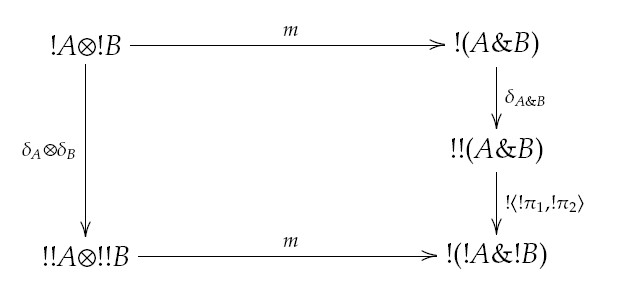
commutes.
As models of Classical Linear Logic
As it stands, a Seely category is a model of intuitionistic Linear Logic. However, the definition can easily be extended to classical linear logic. The key is to ask that the symmetric monoidal closed category
\partial_A : A \to (A \multimap \bot) \multimap \bot
given by currying the evaluation map
References
- An exposition of Seely categories is given in §7.3 of
@incollection{mellies_categorical_2009,
	title = {Categorical {Semantics} of {Linear} {Logic}},
	isbn = {978-2-85629-273-0},
	url = {http://www.pps.univ-paris-diderot.fr/~mellies/papers/panorama.pdf},
	booktitle = {Panoramas et synthèses 27: {Interactive} models of computation and program behaviour},
	publisher = {Soci\'{e}t\'{e} Mathématique de France},
	author = {Melliès, Paul-André},
	editor = {Curien, Pierre-Louis and Herbelin, Hugo and Krivine, Jean-Louis and Melli\`{e}s, Paul-Andr\'{e}},
	year = {2009}
}
- As evident in the name, the original (slightly faulty) definition of Seely categories is due to Robert Seely.
@inproceedings{seely_linear_1989,
	address = {Boulder, Colorado},
	series = {Contemporary {Mathematics}},
	title = {Linear {Logic}, $*$-{Autonomous} {Categories} and {Cofree} {Coalgebras}},
	volume = {92},
	booktitle = {Categories in {Computer} {Science} and {Logic}},
	publisher = {American Mathematical Society},
	author = {Seely, R. A. G.},
	year = {1989},
	pages = {371--382}
}
- The definition given here is sometimes referred to as a "new Seely category, and is a technical improvement upon Seely's original definition. It is due to Gavin Bierman: it appeared in his 1993 PhD thesis, and then was published in
@inproceedings{bierman_1995,
	address = {Berlin, Heidelberg},
	series = {Lecture {Notes} in {Computer} {Science}},
	title = {What is a categorical model of {Intuitionistic} {Linear} {Logic}?},
	volume = {902},
	isbn = {978-3-540-59048-4 978-3-540-49178-1},
	doi = {10.1007/BFb0014046},
	booktitle = {Typed {Lambda} {Calculi} and {Applications}},
	publisher = {Springer Berlin Heidelberg},
	author = {Bierman, G. M.},
	editor = {Dezani-Ciancaglini, Mariangiola and Plotkin, Gordon},
	year = {1995},
	pages = {78--93}
}
See more discussion in §7.7 of Mellies 2009.